
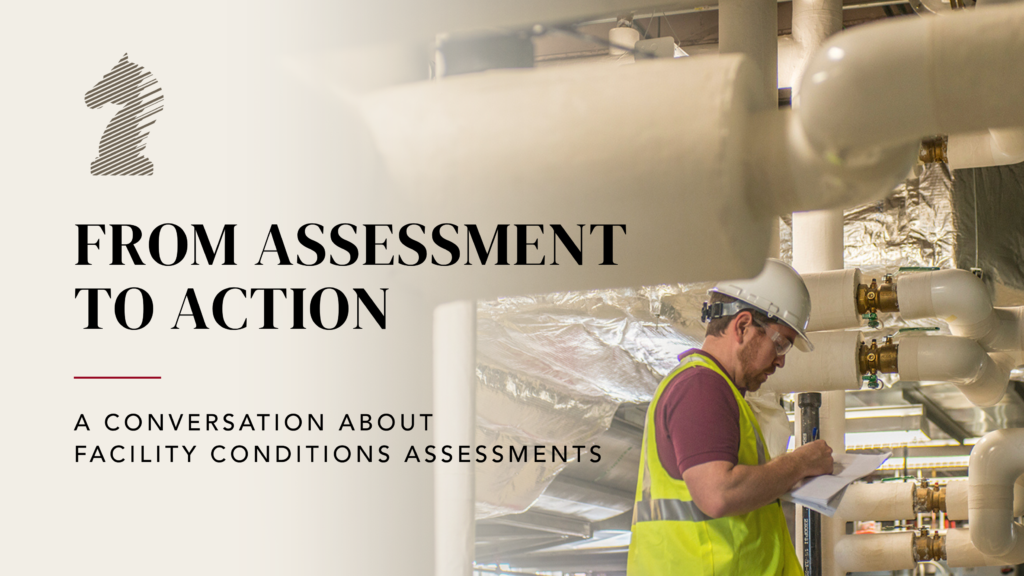
Over the past four years, our commissioning and engineering team completed comprehensive conditions assessments at twelve Department of Juvenile Justice facilities. The effort resulted in detailed equipment inventories, prioritized capital recommendations, and several projects that have already moved into design and construction.
Kelsey Leslie, Mechanical Engineer and Commissioning Team Lead, sat down with fellow Mechanical Engineer Dave Stapleton to reflect on the project, the lessons learned, and why a thorough conditions assessment can become the foundation for long-term facility planning.
Kelsey: Let’s start with your role. Can you describe what you were responsible for during the assessments?
Dave: We completed the work in two phases. Throughout both studies I was responsible for traveling to each facility and gathering data on the mechanical, electrical, plumbing, fire protection, and wastewater systems. We documented the equipment, identified deficiencies, and then developed an evaluation process that considered remaining service life, state of repair, system efficiency, and operational risk. So the objective wasn’t simply documenting equipment—we reviewed the building utility data and operations to assess system performance.
Kelsey: What challenge was the Department trying to solve?
Dave: Many of these facilities were constructed during similar time periods—between 1997 and 2005, which means many of their major building systems are reaching the end of their service life at roughly the same time. We find that many buildings are in need of some system upgrades, refurbishments, or replacements around the 25-year mark.
The Department of Juvenile Justice needed an objective way to determine how to sequence and plan projects. Our job was to replace assumptions with measurable data.
Kelsey: One of the interesting outcomes was seeing two nearly identical facilities produce very different recommendations.
Dave: Yes, the two facilities were built from essentially the same plans within two years—same footprint, very similar equipment. What was interesting is that the conditions were noticeably different. One building ultimately warranted a full HVAC replacement project, while the other still has several years of useful life remaining.
Kelsey: I remember walking through and being amazed at how clean the mechanical systems were. I’ve never seen ductwork above a ceiling look that well maintained.
Dave: I remember that too. Their maintenance manager kept incredibly detailed preventive maintenance records, and you could see the results everywhere you looked. Every space we entered, he was actively maintaining equipment while we were conducting the assessment.
Kelsey: It really demonstrated how much preventive maintenance can influence the life of a building.
Kelsey: How did you make sure the assessments were useful for both facility staff and state agency administrators?
Dave: We knew different people would use the reports differently. Facility managers needed equipment inventories they could reference every day, while administrators needed clear recommendations for capital planning.
So, every facility received both. We documented every major piece of equipment—where it was located, what it served, and its condition—but we also created lists of smaller maintenance items that could be addressed immediately, such as leaking valves, worn belts, damaged insulation, or dirty filters, providing facility staff with actionable improvements they could implement right away.
Kelsey: I really liked that balance. It wasn’t just about million-dollar projects. It also gave maintenance teams a practical list of repairs they could tackle with existing budgets.
Dave: Exactly. We summarized and presented the highest-priority projects and estimated costs so leadership could quickly understand where funding would have the greatest impact. The reporting allowed them to view individual facility needs or review recommendations based on the high, medium, and low prioritization we had assessed using their own criteria.
Kelsey: Were there any findings that required immediate action?
Dave: One walkthrough finding stands out to me. During an assessment, we identified several obsolete electrical panels that represented a recognized life safety concern.
We notified the project team and issued a preliminary recommendation so the Department could begin addressing the issue immediately. Before we released the final report for that facility, there was already a project underway to replace those panels because they took the safety concern seriously.
Kelsey: That sounds like a quick win.
Dave: It was satisfying to see a direct outcome of our work during the assessment phase.
Kelsey: Several projects have now grown directly from these assessments. Were there any that particularly stood out?
Dave: With one location, the facility staff told us they were struggling to maintain acceptable temperatures in the dormitories during the summer.
After evaluating the systems, we confirmed that the existing hydronic system lacked redundancy and that replacing the entire HVAC system would provide a much more reliable long-term solution.
Kelsey: So, Paladin’s assessment validated what the staff had been experiencing every day and gave the Department the documentation needed to move forward.
Dave: Exactly. Their concerns were real, and the engineering analysis provided the evidence needed to support a capital project.
Kelsey: Throughout the project, how important was the input from facility maintenance personnel?
Dave: It was essential.
We can evaluate equipment condition and performance, but the maintenance and operations team understands the building’s history. They know the recurring issues, seasonal challenges, and operational constraints that aren’t always visible during a single site visit.
Combining their experience with our engineering evaluation gave us a much more complete picture than either one could have provided alone.
Kelsey: Looking back over the entire four-year effort, what do you think the lasting value is?
Dave: We gave the Department a roadmap.
They now have a comprehensive equipment inventory, prioritized recommendations, estimated project costs, and a structured way to make future capital decisions.
Kelsey: It really became more than a conditions assessment. It became a planning tool.
Dave: That’s exactly how I see it. It’s been rewarding to watch projects already move into design and construction because it shows the assessments are delivering real value—not just reports sitting on a shelf.
Ultimately, the work helps create safer, more reliable, and more comfortable environments for both staff and residents while giving the Department the information needed to invest wisely for years to come.
A Foundation for Better Decisions
Conditions assessments are most valuable when they extend beyond documenting deficiencies. By combining detailed field investigations, engineering analysis, facility staff collaboration, and practical prioritization, the project provided the Department with a clear roadmap for maintaining and modernizing twelve facilities over the coming years.
For owners managing large building portfolios, that’s the real value of conditions assessments: transforming observations into informed decisions that improve building performance, support capital planning, and create better environments for the people who depend on those facilities every day.